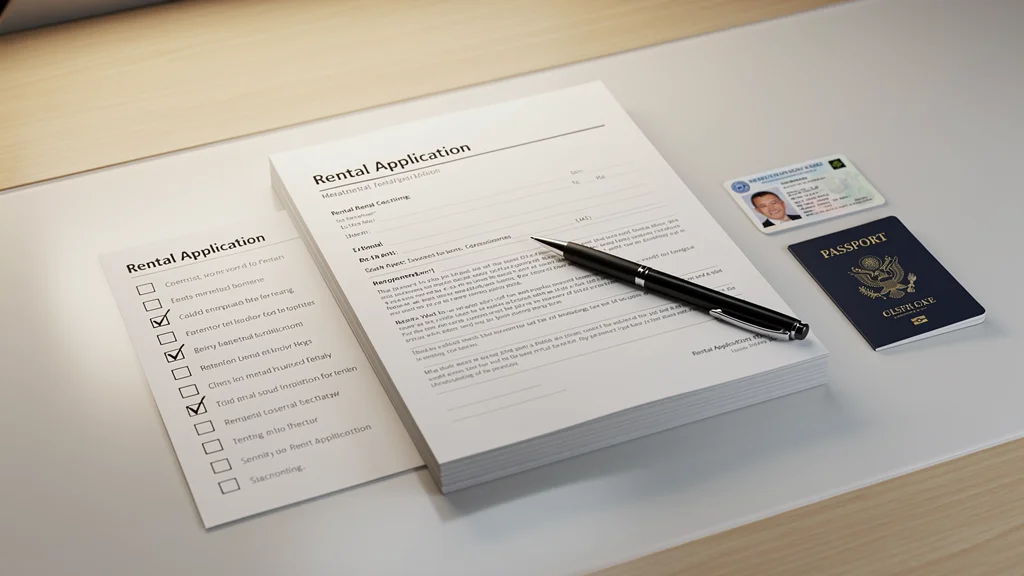
Rental Application Checklist: Documents, Fees, and Timing
Rental applications move quickly and can cost more than expected. A clear checklist keeps you from paying fees before you know the requirements or the real decision timeline.
This guide is general information, not legal or financial advice. It walks through the documents, fees, and timing questions that help you apply calmly and avoid unnecessary costs.
If you are still touring, bring the apartment tour checklist so you only apply to places that fit.
Key takeaways {#key-takeaways}
- A simple document packet prevents last-minute scrambling.
- Written requirements reduce delays and miscommunication.
- Fees add up fast, so confirm totals before you apply.
- Timing questions protect you from paying for a unit you cannot get.
A calm plan before you apply {#calm-plan}
Applying for an apartment is usually faster and more expensive than people expect. This rental application checklist helps you slow down just enough to protect your time and money. It is normal to feel rushed, especially when listings move quickly.
Start by mapping your timeline. If you need a move-in date within two weeks, you will likely apply to fewer places and ask for quicker decisions. If you have a longer window, you can compare options and negotiate a little more. If you are new to renting, review the first apartment checklist before you spend any fees.
The goal is not to be perfect. The goal is to be prepared. A simple checklist and a clean packet will do most of the work.
What landlords usually ask for {#what-landlords-ask}
Most rental applications follow a similar pattern. The exact list varies by building, but the core items are consistent.
Identity and contact details
You will almost always need a government-issued photo ID and basic contact information. Some landlords also ask for prior addresses. Keep your last two or three addresses ready.
Proof of income
Income verification is often the biggest gate. Typical documents include:
- Recent pay stubs.
- An offer letter or employment verification letter.
- Benefit statements if you receive retirement or disability income.
- Bank statements if you are self-employed.
If you want a quick affordability check before you apply, use the Rent Budget Checker.
Rental history and references
Landlords want to know you paid on time and took care of past units. Prepare a short list of references with names, emails, and phone numbers. If you are a first-time renter, you can list an employer or a mentor instead.
Additional items that might be required
Some landlords ask for:
- A co-signer or guarantor.
- Pet records or vaccination info.
- Vehicle details for parking permits.
- A copy of your renter insurance policy (often required after approval).
If you have questions about what is allowed or required, review tenant rights basics and the state overview guide. This is general education, not legal advice.
You can also browse the tenant laws hub for state-specific resources.
Step-by-step: build a clean application packet {#application-packet}
A good application packet does two things. It makes your submission faster, and it makes your information easy to review. That can reduce back-and-forth and shorten decision time.
Step 1: request the exact requirements in writing
Before you pay any fee, ask for a written list of required documents and the screening criteria. If a landlord cannot provide this, treat it as a caution flag.
Ask these questions:
- What documents are required for each applicant?
- How much is the application fee and is any part refundable?
- What is the expected decision timeline?
- Is there a holding deposit and is it applied to rent?
If you want a checklist for evaluating a unit before applying, use the apartment tour checklist.
Step 2: assemble the core documents
Create a folder with these items:
- Photo ID.
- Proof of income (2 to 4 recent pay stubs or an offer letter).
- Rental history and landlord references.
- A basic renter resume (one page).
A renter resume is simple. It includes your name, move-in date, job title, income range, and references. Keep it short and factual.
Pro Tip: Combine all documents into a single PDF labeled with your last name. A clean file makes your application easier to review.
Step 3: prepare backup documents for special situations
If you are self-employed, include three months of bank statements and a short summary of your business. If your income is seasonal, include documentation that shows annual totals. If you are a student, add a letter of enrollment and financial support.
For co-signers, ask what documents they must provide and whether they need to complete a separate application.
Step 4: confirm timing and next steps
This is where many renters lose time. Ask how long the screening typically takes and whether applications are reviewed in the order received.
A simple question works: "If I apply today, when should I expect a decision?"
If the landlord cannot give a clear answer, consider waiting or applying elsewhere.
Copy/paste template: Requesting requirements {#copy-paste-template}
If you feel unsure about what to ask, use a short, polite message. It keeps the process calm and professional.
Hi [Name],

Thanks for the tour. Before I submit an application, could you share the full list of required documents, the application fee, and the expected decision timeline? If there is a holding deposit, please let me know how it works and whether it applies to rent.

Thank you,
[Your Name]
This script works for most situations. It is direct, clear, and easy for a manager to answer.
Organize your documents in 15 minutes {#organize-docs}
You do not need a complex system. A simple folder structure is enough.
- Create one folder named "Rental Application."
- Add a subfolder for each unit you apply to.
- Save your core documents in the main folder.
- Save unit-specific items in each subfolder.
- Rename files clearly so anyone can understand them.
Example file names:
Garcia_ID.pdfGarcia_PayStub_Jan.pdfGarcia_OfferLetter.pdfGarcia_References.pdf
This makes it easy to apply quickly without sending the wrong file. It also prevents mistakes if you apply to more than one unit.
Fees, deposits, and timing clarity {#fees-timing}
Application fees can add up quickly. Two applications at $50 each is $100. Four applications is $200. Confirm the fee and refund rules before you apply.
Ask for a total cost view, not just base rent. Common add-ons include:
- Admin or processing fees.
- Monthly utility or service fees.
- Parking, storage, or amenity fees.
For a breakdown of hidden costs, read the hidden rental fees guide. Then use the Hidden Fees Estimator to compare two units on equal footing.
If the rent is close to your limit, consider reading the how to save money renting guide before you apply. It can help you decide whether the unit is realistic.
Warning: Do not pay multiple application fees at once unless you can afford to lose them. Prioritize the units that best fit your budget and needs.
How to prioritize applications without wasting fees {#prioritize-applications}
If you are deciding between multiple units, use a simple ranking system. Give each unit a score for price, condition, location, and management clarity. Then apply in order, starting with the top option.
Here is a quick example:
- Unit A: Great location, higher rent, clear fees. Score: 8/10.
- Unit B: Cheaper, unclear fees, vague answers. Score: 5/10.
- Unit C: Slightly smaller, good management, clear lease. Score: 7/10.
In this case, apply to Unit A first. If the response is slow, apply to Unit C next. Avoid paying for Unit B until you understand the fees and rules.
This approach protects your budget and keeps your choices open.
Special situations and how to handle them {#special-situations}
Many renters worry that a single issue will block approval. In reality, most situations have workarounds if you communicate clearly and provide the right documentation.
First-time renters with limited credit
If you have no credit history, ask whether a co-signer is allowed or if a larger deposit is acceptable where legal. If you have steady income, highlight that in your renter resume.
Self-employed or variable income
Document your average monthly income using bank statements and invoices. Include a short summary of your business. This shows stability even if your pay varies month to month.
Roommates applying together
Clarify whether all applicants are screened and whether the income requirement is combined or per person. Put your rent split in writing. That protects everyone later.
Recent eviction or disputed record
If you have a prior eviction or a record you believe is inaccurate, you can still apply in some situations. Provide context and be honest about timing. If you believe a record is wrong, you can request details from the screening report. This is general education, not legal advice.
For broader context, review the security deposits and evictions overview.
Recent job change or relocation
Offer letters can replace pay stubs when you are changing jobs. If you are relocating, ask whether the landlord can review your packet before you arrive. Many can.
For a deeper look at screening criteria, read the tenant screening guide.
What happens after you are approved {#after-approval}
Approval is not the final step. Take a moment to review the lease and confirm the move-in details.
- Ask for a copy of the lease before you sign.
- Confirm the total move-in costs and due dates.
- Schedule a move-in walkthrough and take photos of the unit.
- Ask how and when the security deposit will be returned.
If you are unsure about lease terms, review the how to negotiate rent guide and the tenant rights basics for general education on common clauses.
Protect your information and avoid scams {#protect-info}
A professional landlord will provide clear details and a consistent process. If you are asked to wire money, share sensitive information before a tour, or use a personal email with no details, slow down.
Simple ways to protect yourself:
- Confirm the property address and manager name.
- Tour the unit before paying any fees when possible.
- Use official payment methods.
If you want to review a lease for common red flags before signing, use the Lease Red Flag Scanner.
Quick application checklist {#quick-checklist}
Use this checklist before you submit any application:
- I confirmed the total monthly cost (rent + fees).
- I have the required documents in one folder.
- I know the application fee and refund policy.
- I asked about the screening timeline.
- I am confident the unit fits my budget.
If you can check all five, you are ready to apply.
FAQ {#faq}
What documents do I need for a rental application?
Most landlords request a photo ID, proof of income, and rental history. Some also require references or a co-signer. Ask for the full list in writing before you pay any fee.
How much are rental application fees?
Fees vary by market and property type. Always ask for the exact amount and whether any part is refundable. Compare costs across properties before applying.
Can I apply with no credit history?
Yes. Many landlords accept a co-signer, higher deposit where allowed, or stronger income documentation. Ask about options up front.
How long do rental applications take?
Some decisions are same day, while others take several days. The timeline depends on the screening vendor and property process. Always ask before you apply.
Do I need a renter resume?
It is not required, but it helps. A short one-page summary can make your application easier to review and shows you are prepared.
Should I apply to multiple apartments at once?
Only if you can afford the fees and the units meet your needs. A targeted approach is usually safer and more cost-effective.
Next steps {#next-steps}
If you are preparing to apply, use the apartment tour checklist to evaluate units first. Then read the tenant screening guide so you understand how approvals work.
For affordability, run the Rent Budget Checker and the Hidden Fees Estimator. If you want a full, step-by-step path, start at the Renting Guides hub.
Disclosure: Some resources mentioned in this guide may include affiliate partnerships. See our disclosure for details.